Part One
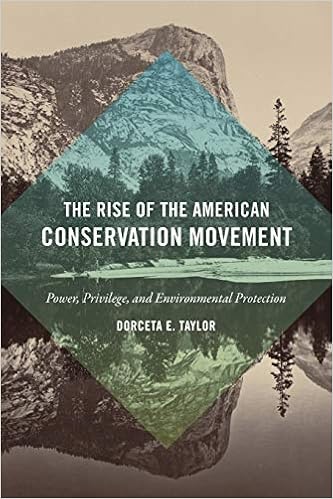
Where do I even begin with this book? It is absolutely a must-read for anyone in the environmental science and policy fields. I did not want to attempt reviewing or adding any thoughts to the book so I decided for this post to summarize twelve things that I learned and found impactful in this book with the hopes it will encourage at least one other person to read it. First and foremost, Taylor’s writing is phenomenal—I read this book as easily as I would my favorite novel. I cannot praise this book enough.
Summary: Dorceta Taylor presents a well researched history of the American conservation movement’s origins, weaving in the interactions of race, class, gender, and immigration status with environmental policy and the conservation movement. She tells the seemingly forgotten stories of women and people of color in the environmental movement that has since its origins been dominated by privileged white men. I am going to break this summary up by chapter to provide an overview of the topics Taylor dives into in this work.
Chapter I: Key Concepts in Informing Conservation Thought
This chapter sets the stage for the rest of the book; Taylor defines key concepts that will aid the reader in understanding the often complex topics Taylor discusses. I knew this book was worth the purchase when I came across a concept I have never heard of before—internal colonialism. Internal colonialism is the exploitation and experiences of minority groups (internal colonies) at the hands of the majority group within a nation. Many of the same processes of external colonialism are at play in internal colonialism; “Economic dependence of the internal colony is reinforced by legal, political, and military measures.” An example of this that Taylor discusses is the relationship between Native American reservations and the U.S. government.
Chapter II: Wealthy People and the City—An Ambivalent Relationship
In this chapter Taylor describes the conditions of urban cities that served as an “Impetus for Change” (that is what this part of the book was titled) for urban elites seeking escape from American cities—disease, lack of sanitation, riots and civil unrest, overcrowding. What I found interesting in this chapter is that the earliest conservation efforts took place in urban areas with the establishment of city parks. Muir is typically associated with the formation of the American conservation movement, but these early efforts within urban spaces from the mid-nineteenth century are very different from Muir’s seeking of grandeur wilderness undisturbed by humans. I found this intriguing because I think there has been a return to these early ideas of making urban spaces greener. Urban spaces are not separate from the environment, they are their own type of ecosystem in a way and have great potential for the environmental movement.
Chapter III: Wealth, Manliness, and Exploring the Outdoors
Taylor describes two types of men exploring the outdoors in this chapter; transcendentalists, and the more adventurous frontiersmen seeking excitement from their interactions with nature. Were transcendentalists the original cottage core? It seems so. People like Emerson and Thoreau praised pastoral life for its simplicity and charm, leading to an increased emphasis on making farms and country estates more attractive. On the flip side, some men asserted their masculinity by taking to the frontier for sport and adventure. People like Theodore Roosevelt extolled the benefits of exercise on the rugged frontier and hunting for sport. Taylor does not say very much on the matter but I kept thinking of the ways both groups of men led to dangerous ideas of Native American people’s relationship with the land. Muir was not subtle in his beliefs that Native people were primitive and did not belong in the natural areas he wished to conserve despite them having been stewards of that land for generations. Hunting for sport also harmed Native people, most notably in the over-hunting of bison populations on the plains and treatment of Native people as if they were less than human.
Chapter IV: Wealth, Women, and Outdoor Pursuits
For every man mentioned in the previous chapter, Taylor told the story of women doing the same work. It is not often discussed, but women were also nature illustrators, landscape painters, adventurists, naturalists, botanists, miners, etc. alongside their male counterparts. I do not have much to say about this chapter other than I learned about a lot of women whose stories should be told in addition to Muir, Audubon, Thoreau, and Emerson.
Chapter V: People of Color—Access to and Control of Resources
My take away from this chapter is that two important women of color we all learn about in history class are not talked about nearly enough—Sacagawea and Harriet Tubman. Of course, anyone who paid attention in history class knows their story but I feel like what they both did is not emphasized enough because only recently in learning about them did I understand the scale and gravity of their feats. Both of them undertook incredible journeys that rivaled and surpassed any male adventurer. They both relied on their intimate knowledge of the land to guide themselves and others safely across the country and, in Tubman’s case, extremely perilous conditions due to the illegality of her heroic actions. The relationship enslaved people and Indigenous people had with the land is not discussed enough in environmental circles (especially the former). That is finally starting to change, but I still see people acting as if Muir was the first person to ever go for a walk in nature; Indigenous people had extensive trade routes throughout the continental United States, there was no such thing as uncharted or untraveled territory when Muir decided to go on those journeys.
Chapter VI: Sport Hunting Scarcity and Protection
This chapter was an overview of the establishment of hunting and fishing regulations. My main take-away from this chapter is that the divisions of class present in hunting back then is the same as it is now. Lower income, subsistence hunters were villainized as the reason for game scarcity and animals nearing extinction. Meanwhile, the same elite hunters that villainized subsistence hunters would casually write about the ways they over-exploited game, and bragged about possibly shooting the last individuals of species nearing extinction. That sounds somewhat familiar, doesn’t it? It makes me think of the way Indigenous people that hunt and fish in the traditional ways they have always used for subsistence, are often portrayed as greedy, barbaric, or wasteful. These false views of Indigenous people have led to conflicts over natural resources for decades, more recently in Nova Scotia with the lobster fishery. Non-Indigenous commercial fishers used violence to intimidate and harm First Nation fishers, accusing them of overharvesting, despite the fact First Nation fishers make up an absurdly small portion of fishers in that region.
I will continue this discussion in another post at a later date, I hope you enjoyed and thank you for reading!
 Learning How to Science