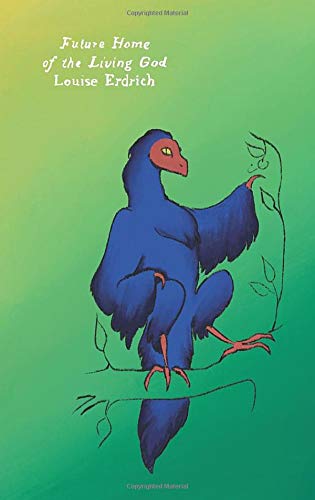
My most recent read is Louise Erdrich’s Future Home of the Living God. It was an impulse purchase because I loved the cover and it seemed, from the startlingly unfamiliar picture of the bird on the cover, that it was going to be different from previous works of hers that I have read.
The story seems fairly normal at the onset. You follow the main character Cedar, who is a young Native American woman who was adopted outside of her community, as she attempts to learn the truth of her family history and locate her birth mother. The separation of Indigenous children from their parents by placing them in boarding schools and later on into white homes was a deliberate attempt by the government to erase Indigenous culture by assimilating Native children to Anglo-American society. Near the end of the twentieth century action was taken to prevent Native children from being adopted into non-Native homes. The fact that this book is set in a contemporary setting gives both Cedar, and the reader, reason to question the ethics of her adoption. As the novel continues however, there are hints that this world is not anything like our current America; there are mentions of evolution reversing in non-human species, and the panic escalates as it is made apparent that the sudden evolutionary changes are inevitably going to affect the human population as well. Cedar is in an especially vulnerable position, but I do not want to spoil anything more than that because what I enjoyed most of this book was all of the bizarre twists and turns that it took. In summary, it was Annihilation meets The Handmaid’s Tale and I loved it.
The reason I wanted to feature this book on this blog is because I am starting to dive into speculative fiction and other ways climate change or environmental science pop up in popular culture. While the science is of course not good and highly exaggerated in this book, it painted a very vivid picture of how our society might respond to a catastrophe such as this. The author’s perspective as an Indigenous woman is especially intriguing because of the way she weaves historical infringements on Indigenous women’s rights, specifically reproductive rights, into the contemporary setting in a horrific way.
Novels that center environmental issues are so important to communicating to the general public. No, Louise Erdrich is not a scientist, and no, evolution is not going to spontaneously reverse (at least I hope not) but it definitely got me thinking about how society responds to natural disasters outside of our control. It is often “too little, too late” or “let’s wait until after something bad happens to us to do something”, and that is what appears to have occurred in this novel. I appreciate any novels that blend environmental issues and social injustice, as the two go hand in hand. Climate change, like the conflict in this novel, is going to upend our world and change the ways we live drastically, how will our society respond? So far it has been a rocky road and we are only at the base of the mountain we have to climb in order to adapt and mitigate climate change.
I really do not have anything negative I could say about this book, other than I want to know more about how the world got up to the point of where the story began! There are many startling descriptions of how the evolutionary reversal is playing out in the world around Cedar, but I wish there was more. In general, I wish there was even more world building because what Erdrich does present is phenomenal. I would highly recommend this book to anyone interested in dystopian or post-apocalyptic literature. I am hoping to find more fictional literature that explores topics such as environmental issues, or speculative fiction that is set in a post-environmental disaster world. Books and articles about climate science are not accessible to a large portion of the general public for a variety of reasons, but books such as this are a good way to relay to readers the devastating impacts of environmental disasters that can and will disrupt our current ways of living, and the sense of urgency to take action against them.
 Learning How to Science