Welcome back and thank you to those of you that liked my last post and subscribed! In my last post I left off on the first week of my 2018 summer internship with the South Carolina Department of Natural Resources through the College of Charleston’s Fort Johnson REU (Research Experience for Undergraduates) program. I had moved to a new city, came up with a research idea, designed an experiment, and now I was ready to begin putting my plan into action. Let’s go!
The goal of my experiment was to rear crab in a lab to test how male and female juvenile blue crabs respond to varying salinity (salt level) conditions by measuring growth rates over time.
I estimated that I needed about one hundred crabs for my experiment, but there was one problem. That is A LOT of crabs, and we specifically needed juvenile crabs less than three inches wide. I began by going out with the field scientists in my department a few times a week and helping them with their work. I would bring home any juvenile blue crabs we caught during our trawls of the tidal creeks around Charleston. After two weeks this method was not going very well. I brought home twenty crabs and all of them died. Now might be a good time to mention, I know not everyone agrees with doing experiments like this and I had reservations about this too. I had originally wanted to do a field experiment so that we did not have to capture live crab and rear them in a lab, but another way to think about it is that this work could be used to ensure healthy crab populations persist for generations to come. Also blue crab populations are not currently threatened.
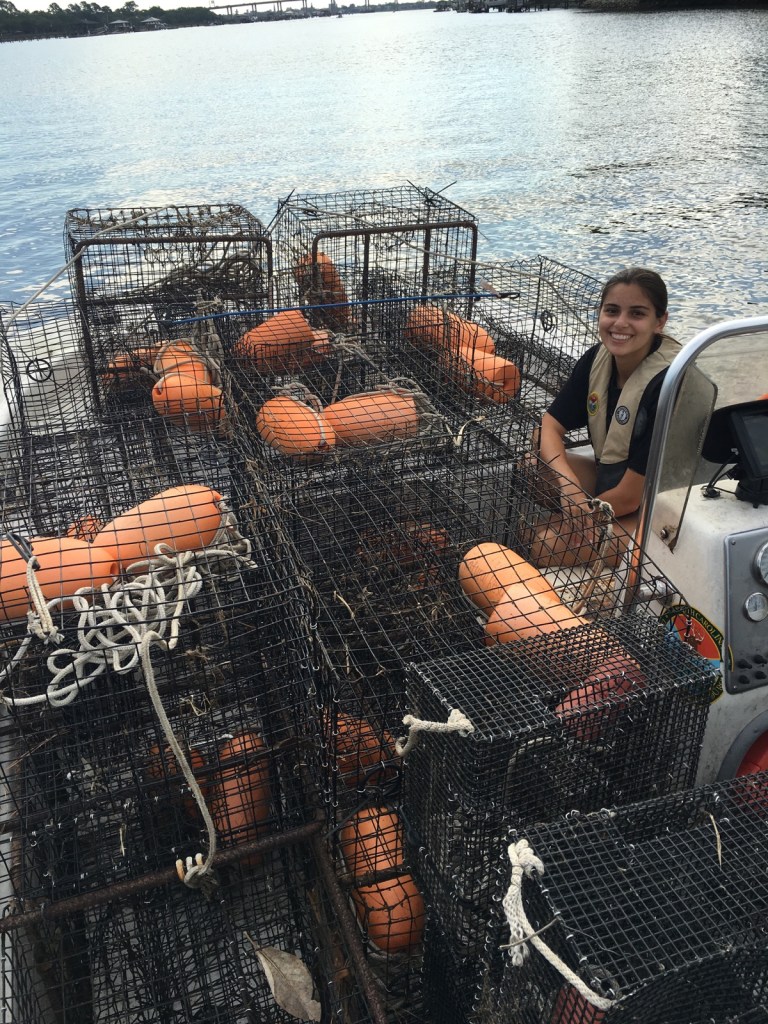
After those initial two weeks of already intensive fieldwork, we decided to kick it up a notch and do a targeted approach to the creeks we found the most juvenile blue crab in. Four days a week we set out crab pots, trawled, and I even used nets to pick up ones I saw swimming near the surface. I figured out a system to keep them cool during transport and learned not to take the smallest crabs that would be less likely to survive the move to the wet lab. It was exhausting work, and I can write a whole post about fieldwork mishaps I experienced, but I enjoyed being on the water everyday and being busy. I even got to drive the boat sometimes!

During these fieldwork heavy weeks my normal schedule was to get up around 7 A.M. to eat breakfast and pack my bag for the day. I would be out by the boat at 8 to help load the equipment in. Then we would drive to wherever we were sampling that day and be on the water from about 9 A.M. to 4 P.M. It was really physical work because I would have to throw the crab pots out or bring them in by hand, and pull in trawls by hand, so I came home exhausted. I would eat dinner and work on my computer for a while. At 9 P.M. I would leave to help a graduate student with her research. We would bring big nets to docks around Charleston two or three nights a week and stay out until around 2 A.M. because she needed larvae samples for her project. It was a lot of fun and I was glad to help, but hearing that alarm going off a few hours after I got home was the worst feeling. But that’s what coffee is for! These crazy hours are something to consider when thinking about REU’s. I definitely did not have to work as much as I did, but I figured that is what I was there to do and I wanted to give back by helping the people who spent so much time helping me with my project.
Getting back to the wet lab, I now had fifty crabs in their individual containers that protected them from each other and allowed me to keep track of individuals by numbering the containers. These containers were actually plastic Chinese take-out cups for soup that were cleaned and hole punched! Being resourceful was an important skill I learned here, because I had to figure out how to use what I had around me in creative ways. It was fewer crabs than I had hoped to collect, but I needed to begin my experiment so that we had enough time to measure the crab’s growth. I spent a whole afternoon running random number generators to assign the crabs to one of the sixteen tanks I had set up so that the males and females were evenly divided among the two different experiment conditions: high salinity and low salinity. I ended up with two males and one female in each tank, except for two that had two males and two females.
How I ran my experiment
Once the crabs were in their appropriate tanks the waiting began. I had a weekly and daily schedule for my experiment to make sure I was keeping track of the data I needed for my paper, and taking good care of the crabs. Developing and following this schedule was super important because doing good science requires diligence and consistency. Especially in a laboratory setting, you have to control what you can about the experimental conditions to eliminate other factors that could potentially affect your results. For example, the sixteen tanks were divided onto four racks that had a top shelf and bottom shelf. I would make sure I had a high salinity and low salinity tank on each shelf to account for variations in light that may result from the top shelves blocking the overhead lights from reaching the bottom shelves.
Every morning I would put food pellets in their containers and feed them to satiation. I did this by putting five pellets into each container, and if one of the crabs ate them all I would add more. In the afternoon I would return and see who still had food left in their containers and I would remove it so that it did not make the water and tank dirty. Every two or three days I would use pH strips to test the water and make sure it was at a healthy level. There were also temperature logs in each tank measuring the temperature constantly throughout the experiment. At the beginning of every week I would do a half water change. I did this by siphoning out half of the water from each tank with a hose into the drain, and then pumping water from one of two garbage cans I had set up with water at the proper salinity levels. One was the “low salinity” water at 5 ppt (parts per thousand) and the other was the “high salinity” water at 15 ppt. I had to make it by mixing salt in by hand with a paint stirrer taped to a broom handle. The water changes were definitely the most work because the hoses and water pump could be heavy when I was tired from field work, and it took almost all day to complete. It was necessary though because having clean water for the crabs allowed them to stay healthy and not let gross algae build up on the sides and bottom of the tanks.
Friday was the most important day. I would take all of the crabs, tank by tank, to another lab down the hall that had a small scale and calipers. I would get the wet weight of all of the crabs and record it. The wet weight is just a measure of an aquatic organism’s weight without going through the process of drying it out. Then I would use the calipers to measure the length, width, and height of every crab and record that. Then the crabs would go back to their tanks and I would enter all of that data into an excel file. Whenever a crab molted I noted the molt event in my notebook and would use the calipers to measure its dimensions too because when they molt that means they grew larger and needed to make a new shell. I did this for five weeks because at the end we used the wet weight and changes in body dimensions to see how much the crabs were growing. More on how I did this will be in the next post!

After five weeks of caring for my little crab babies, it was time to wrap up my experiment. The crabs were stored in a freezer with labels in case they are needed again in the future. I was really upset that I could not release the crabs, but since they were in aquariums and in contact with me they could have picked up diseases that we do not want getting into the wild population. Although it was difficult, I hope the results of my study can be helpful in some way because as I will discuss in a later post, they were relevant to the issues populations may face due to changing environmental conditions as a result of climate change.
I am really happy with the work that I did during this period of my internship. It gave me a ton of fieldwork experience and chances to help with other projects not related to my own, as well as laboratory experience. It was a good balance for me because I love getting outdoors and Charleston’s estuaries are beautiful, but fieldwork is also very time consuming and demanding. The laboratory portion of my project was great for when I needed more time indoors to work on my writing and data entry and analysis.
Up next will be a post about what I did to go from raw data to results to full fledged manuscript all in the span of a week!
 Learning How to Science